This article appears for archival purposes. Any events, programs and/or initiatives mentioned may no longer be applicable.
By Mira Radovich, Senior Contributing Writer
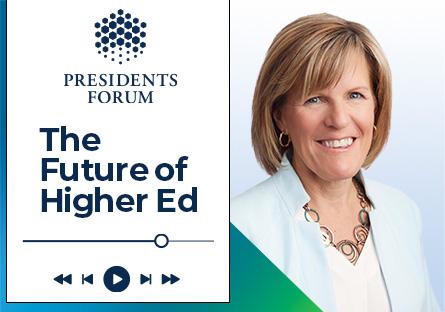
This summer, Rio Salado College President Kate Smith shared her thoughts with the Presidents Forum on key education topics including the future of distance education, artificial intelligence in learning, and how the innovative use of technology and personalized support can benefit adult learners.
The Presidents Forum, founded in 2002, is an organization of college and university presidents and chancellors, as well as leading education stakeholders, committed to reinventing higher education for a diverse student population. Smith joined as a governing board member in 2020 and currently serves as vice chair.
AI, Workforce Blog
Smith wrote an opinion piece, published on July 25, 2025, entitled, “AI, Workforce Development, and HigherEd Convergence— Redefining the Learning Experience. The article discusses the need for collaboration among educators, employers and policymakers to harness AI in ways that build a stronger and more equitable workforce.
“By working together and prioritizing the convergence of AI and workforce development, we can serve a greater number of learners, expand industry partnerships to build a robust workforce, create new revenue streams, and influence the advancement of artificial intelligence,” Smith wrote.
She pointed to the growing role of microcredentials and credit-for-prior-learning programs that help learners quickly gain in-demand skills— especially in AI— while stressing the need for clear standards so employers value these credentials.
Smith also noted that technology alone can’t remove the real-life issues many adult learners experience.
“What AI cannot address are the many challenges adult learners face,” Smith wrote. “About 40 percent of all U.S. workers are low income. … It makes sense we invest in scholarships and support services that address homelessness, hunger, and other issues preventing learners from completing their goals.”
In her call for change, Smith also stressed the need for “flexible options” that allow learners to balance work, family, school and life.
“We have an awesome responsibility,” Smith said. “I am confident if we share resources and strategies, rethink our traditional roles, and redefine the learning experience— we will make education and employment more equitable and accessible— and create a thriving workforce of the future.”
Future of Distance Education Podcast
In a recent episode of the "Presidents Forum Podcast," host Marty Carpenter, executive vice president of communications for the Presidents Forum, invited Smith, along with University of Maryland Global Campus President Dr. Gregory Fowler and Alamo Colleges District Chancellor Dr. Mike Flores to discuss the innovation, technology and personalized support used to serve adult learners.
The presidents talked about how AI is reshaping distance learning at a time of great intersection between innovations, emerging technology, and personalized learning.
Smith shared her enthusiasm for AI, noting the scale of what’s happening with the evolution of the technology.
“The level of personalization we’ll be able to lean into is really exciting,” she said, adding that with the emergence of AI the question arises for faculty to think about what it will be like to teach their field five years from now.
“As these technologies keep evolving at such a rapid pace, the World Economic Forum cited that 50 percent of all workers will need to upskill or reskill within 5 years,” she said. “If we think of that trend continuing into the future, we recognize the need for agile and rapid development.”
Building a Culture of Student Success Podcast
In a separate podcast with Wesley Smith, executive director of Presidents Forum, Smith shared the various resources Rio Salado provides to all learners.
“Rio, being one of the first in the country to go online in the mid-90s, really keyed into those student services. It’s in the DNA of the institution,” Smith said. “You’ve got to meet basic needs to increase student success.”
She continued to share about various tools available to students and staff to increase student success that are part of the emerging technologies in higher education.
“Technology is evolving so fast. We went through a global pandemic. Everyone became more reliant on technology; however, that human interaction dynamic is still critically important so we’re always grappling with, ‘How do we make sure our students have those social interactions that we know are critical to success?’”
She pointed to one example, RioConnect, an online community where students can interact with other Rio Salado students, much like a social media platform. Rio Salado College also uses a custom predictive analytics program to look for “signals” that students may be at risk for dropping a class. “Then we use proactive outreach,” she said, which has helped boost student persistence rates by 5 percent.
The podcast host also asked Smith about the many responsibilities adult learners have to fit into their schedules: being caregivers to children or aging parents, as well as working.
“That is our largest population of students. We spend every day thinking about how we can iterate and get better at it,” Smith said.
Smith highlighted how Rio Salado’s learner-first philosophy and commitment to breaking down barriers ensure that all students have access to comprehensive support, including the availability of life coaches, mental health resources, and success coaches to various student populations.