This article appears for archival purposes. Any events, programs and/or initiatives mentioned may no longer be applicable.
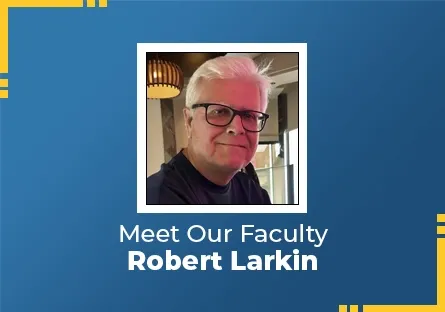
Robert Larkin is a man of many hats. While he may not wear Indiana Jones’ trademark hat, he shares a profession with the esteemed Doctor Jones as an archaeologist. He also wears the hat of Rio Salado College Adjunct Faculty in Social Sciences. And then there’s his work in environmental planning, cultural anthropology, and global health. As of this summer, he can add another hat to his collection: graduate of a prestigious public health leadership program at Harvard!
Larkin has worked for Arizona’s state government as an archaeologist and land use planner, with more than 20 years of experience as an environmental consultant under his belt. Larkin’s career as an educator began in earnest in 1998. “It started as a second job to maximize my income,” Larkin said.
He started teaching management and environmental science for the University of Phoenix and Ashford University. Larkin taught at several other for-profit and non-profit colleges (including Franklin University in Columbus, Ohio) before becoming an instructor at Rio Salado in 2012. Larkin has received two Outstanding Faculty Awards during his time at Rio Salado, and also received a Teacher Excellence Award while he was teaching at Franklin University.
“For my 9-to-5 job at the time, I was writing archaeology monographs and environmental impact statements during the day, then teaching similar subjects online in the evenings and weekends,” Larkin said.
Larkin initially pursued a major in marine biology before pivoting to anthropology, “after realizing the fascination of culture change and the comprehensive study of humanity.” Larkin credits his studies in anthropology for expanding his awareness into other areas of interest.
“Learning more about anthropology triggered more specific interests in medical anthropology and global health,” Larkin said.
Reflecting on his favorite era of history, Larkin keeps it close to home.
“I’ve always been fascinated by the boundary between prehistory and history in the State of Arizona,” Larkin said. “This is usually recognized as occurring in the 16th century when the Spanish arrived and began keeping written records. I’m especially interested in the cultural changes that have occurred since that time, including changes in public health.”
Larkin has called Arizona home since he was 11 years old, after a childhood spent on the move from Air Force base to Air Force base. Larkin’s father was assigned to Davis-Monthan Air Force Base in Tucson, planting lasting roots in the Copper State for his family. Larkin would begin his higher education journey in Arizona, attending the University of Arizona to earn a bachelor’s in anthropology and a master’s in environmental planning. He would later go to ASU to pick up a master’s degree in anthropology.
The most recent feather in Larkin’s cap was being admitted to the global public health leadership program at the Harvard University T.H. Chan School of Public Health, which he finished in June of this year.
Larkin began pursuing a certificate on innovation in public health when his department faculty chair, Tristan Marble, asked him to develop a new course in global health.
“I hope to make positive contributions to global health,” Larkin said. “I am especially interested in the provision of medical care to underrepresented communities, the future of telehealth, the use of artificial intelligence in medical research, and the importance of cultural competence and cultural humility in public health and global health.”
Larkin retired work as a consultant at the age of 65 but continues to remain active and engaged as an educator.
“I continue teaching online because it continues to be very important to me.”
Article by Austin Brietta