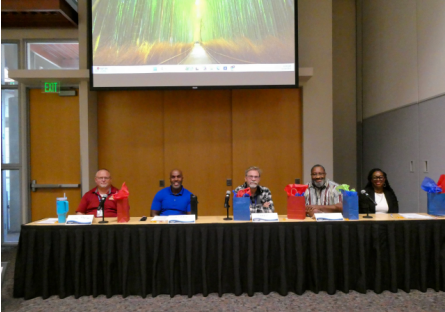
In the words of Winston Churchill: “Never was so much owed by so many to so few.” November is a time for reflection, respect, and raising up our veterans. As part of a Veteran’s Day celebration, Rio Salado College hosted a live panel discussion at the Rio Conference Center on Monday, Nov. 10, called “Let’s Taco ‘Bout It: Veteran Appreciation & Stories of Resilience.” This event brought together a group of Rio Salado employees who are also veterans to share shared their experiences inside and outside the armed forces before panelists and audience alike adjourned to enjoy a taco bar lunch.
The panelists featured veterans who served in the Marine Corps, Air Force, and Navy:
- Randy Anderson: IT Support Specialist Sr. In the Air Force he served as a jet engine mechanic, A-10 crew chief. He retired as a Master Sergeant.
- Damon Hutchinson: IT Support Specialist. He served in the Navy as a radioman setting up voice circuits for the fleet before transitioning into data processing.
- Shira James: Testing Technician. She served as a nondestructive inspection technician in the Air Force and worked in a variety of supportive roles maintaining jets and flight line/backshop support before medically retiring in 2017.
- Daniel Phelan: HR Program Manager. He joined the Marine Corps in 1989 and served until 1993 and is a veteran of Desert Shield/Desert Storm.
- Courtney Salmon: Student Service Specialist. He served in the Air Force for 20 years, 14 of which he spent as a unit training manager.
After some thoughtful opening remarks by Rio Salado Vice President Dr. Sarah Vandermark, the panel launched into a dialogue about their experiences re-entering civilian life after dedicating so many years of their lives to military duty. Two recurring sentiments shared by all five panelists was their gratitude for their time in the services, as well as a frank admission about the struggle of integrating back into civilian life and lack of resources from the military to do so.
“You can’t do anything for the time that we’re talking about and just go back to normal,” Salmon said. “It takes some time to acclimate and adjust.”
Phelan suggested talking to veterans about their experiences can be a way to make them feel welcome and “normal” once they’re no longer active.
"For every veteran- whether you've been in a combat situation or not- telling stories is a release,” Phelan. “Because we're proud of what we've done, we’re proud of our service.”
The panelists also agreed that joining the services- while a life-changing, beneficial experience for each of them- also incurred sacrifices.
“When I started, I didn’t think there would be a time where I would have to explain to my 5 year old that I was going to be gone for a year and having her cry and not understand, or having my wife cry as I listen to things she’s doing that I can’t help her with because I’m on the other side of the planet,” Salmon said. “Missing funerals and weddings and birthdays… that’s hard to come to grips with. The weight of those sacrifices catches up after a while.”
James, who served around the same time as her husband, talked about what it was like to be married to a fellow service member.
“On one side, it was pretty cool because we both had been through a lot of the same experiences as far as leaving our families, going through basic,” James said. “We had that connection. We could share that with each other. We were able to rely on each other to deal with stressors.”
Those stressors included childcare: James talked about how often one of them would be gone for extended periods of time to serve elsewhere, leaving one of them to parent alone. It touched on an interesting contradiction of military life that the panel addressed: that military life is both intensely structured while also being unpredictable.
Hutchinson, reflecting on how the Navy prepared him for his work at Rio, talked about this very sense of unpredictability being an asset for his personal and professional growth.
“Being flexible, being able to adapt to any situation,” Hutchinson said. “In the Navy, I started as a radioman but then the Navy was like, ‘No, you're in IT now, you have to learn computers.’ So learning how to roll with the punches and being ready to go was essential.”
Anderson, a flight line mechanic so distinguished he got the rare honor of having his name painted on the side of a jet, talked about how much he enjoyed being stationed in Germany. He also told a story about how, after learning how to use a machine to engrave flags for members retiring from duty, found out that the company making that exact machine were based in Arizona. He got his first job after the Air Force at this company and ended up learning how to build and manufacture the very machine he was first trained on as an enlisted mechanic.
When the event got to the audience Q&A portion, one of the more interesting questions was which of the branches of the military would the panelists recommend if someone’s child was interested in joining.
“I chose the Marine Corps because it was the hardest. I wanted something very, very difficult to challenge me both mentally and physically,” Pheland said. “You’re going to come out of the Marine Corps boot camp with a different sense about you. A sense of pride. You earned something. If you complete that crucible, then you get your Eagle, Globe, and Anchor and you’ll treasure it for life.”
For James and Hutchinson, in addition to all the technical training and camaraderie that comes with being in the Air Force and Navy, they emphasized the benefits of travel and cultural exposure that serving has to offer.
"Seeing how other countries and people lived, it made me appreciate America more and my family and what I had back home,” James said. “I saw some great things and not-so-great things, but it made me appreciate who I am as a person."
“Two years, see the world, and it pays for your college,” Hutchinson said.
Salmon advised that a person considering military service should first ask themselves what they want to do AFTER the Army and pursue the branch that will best train them and prepare them for what they envision their civilian life to be. He recommended finding people in the service already doing those kinds of jobs and get their advice first before talking to recruiters.
“The recruiters are not going to sell you the job that you want, they’re going to sell the job that the military wants,” Salmon said.
At the close of the event, a moving gift was offered to the panelists. Wendy Morris, a Rio Salado Adjunct Faculty who teaches math, shared a story about her deeply meaningful friendship with her husband’s late aunt, Shirley. Shirley’s husband was a World War II veteran who drove General George S. Patton, and Shirley had dedicated much of her life to helping veterans. She was also a deft quilter who taught Morris how to quilt. During the pandemic, Shirley made several quilts and asked Morris to donate them to veterans. It was precisely those quilts that Morris gave to each panelist, who were all visibly moved by the gesture.
Earlier in the event, Phelan reflected on a question to the panel about what should someone who served say when someone comes up and tells them “thank you for your service.” He had a surprising answer.
“I saw a podcast where a veteran was asked that and he replied ‘you were worth it,” Phelan said. “Now I’ve got myself trained to say that. When you say that back to someone, then they’re speechless.”
Morris, the audience, the five panelists holding up their quilts: all were speechless at that moment.
Article by Austin Brietta