Arizona’s semiconductor boom continues to shape the state’s workforce. Today, it’s also reshaping high school education.
In fall 2025, Chandler Unified School District (CUSD) launched the nation’s first standalone, two-year high school semiconductor manufacturing Career and Technical Education (CTE) program at Hamilton High School. Through a dual enrollment partnership with Rio Salado College and supported by Chandler Gilbert Community College, students can earn college credit while still in high school, gaining both academic momentum and real-world experience.
This program was developed in collaboration with Chandler Unified, Rio Salado College, Chandler Gilbert Community College, the University of Arizona; and Northern Arizona University, with financial and strategic support from the Arizona Commerce Authority, local chambers, and industry partners, including Intel.
Learning by Doing in a High-Demand Industry
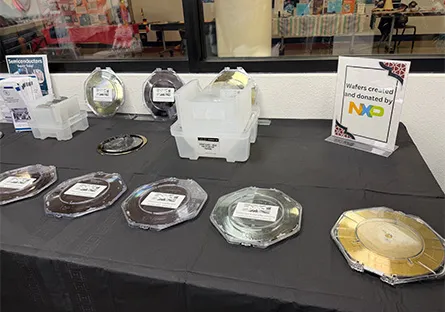
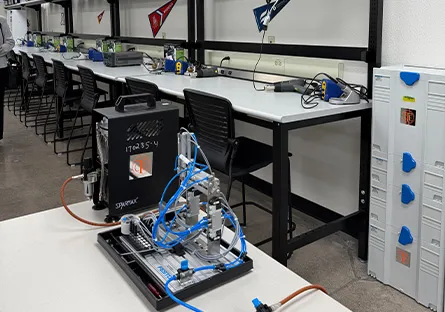
The program blends classroom learning with hands-on, industry-standard training. Students work directly with circuits, transistors, relays, robotics, and simulation equipment.
“We have learned about electricity, what is voltage and what is current and how to calculate them,” said Justin Cope, a freshman dual enrollment student. “Later in the year… we’ve learned about transistors and relays and the actual components you’ll put on the circuit board to make it do what we want.”
For many students, the applied learning is what sets the program apart.
“My expectations were blown out of the water,” shared Sarmud Ahmad, a senior. “I’ve been able to physically interact with different objects, such as semiconductors. I’ve been able to physically see them. In my older engineering classes I would have never had the opportunity.”
Dual Enrollment: A Head Start on College and Careers
A defining feature of the program is dual enrollment through Maricopa Community College, allowing students to earn transferable college credit while gaining exposure to semiconductor careers.
“I decided to do dual enrollment because going to college it would give me a head start on the stuff I’ve already learned,” said Zachary Schafer, a sophomore dual enrollment student. “It will show colleges and other people that hire in the industry that I already have experience.”
For students balancing robotics, engineering, and future career goals, the alignment is intentional.
“This class aligns with what I’m doing outside of school, as well as robotics,” Cope added. “I’m thinking of going into an engineering field… I’m just using it to build some experience.”
Industry Exposure That Changes Expectations
Students also benefit from direct access to industry professionals and events. This year, with SEMICON West in Arizona, that went to another level.
“I was pleasantly surprised by the opportunities, especially by meeting so many people in this industry,” said Shiliah Yeomans, a senior. “From the moment I walked into SEMICON, I was pulled into conversations with representatives… I was able to picture myself in those companies and what roles I can grow in.”
That exposure is key and strategic, according to state workforce leaders.
“Arizona has pioneered training pathways for this key industry,” said Olga Leslie Teran, Workforce Program Manager at the Arizona Commerce Authority. “This first-of-its-kind high school semiconductor manufacturing program provides students early career exposure to the semiconductor industry and the good-paying jobs that come with it.”
Building the Workforce Pipeline—Together
The program was shaped by academic and industry leaders working to address a critical workforce gap.
“This program was built with our partners to meet Arizona’s workforce needs,” said Rick Vaughn, Faculty Chair of STEM Initiatives at Rio Salado College. “By integrating dual enrollment with hands-on semiconductor training, we’re giving students a direct pathway from high school to college credit, careers, and continued education in a vital industry.”
A Model for What’s Possible
For students like freshman Jeremy LaPaglia, the impact is already clear.
“I feel I’ve learned a lot of things in this class that I wouldn’t have learned otherwise,” he said. “I can build circuits. I can explain technical information in a way someone not in the field could understand. Those little things can go a long way on a résumé.”
As Arizona continues to attract billions in semiconductor investment, programs like this one ensure students aren’t just watching the growth— they’re prepared to lead it.
“This program wasn’t built by one institution, it was built by a community,” said Janet Hartkopf, coordinator of emerging technologies for Chandler Unified School District. “Curriculum contributions came from partners all over the country, from industry labs, post-secondary faculty organizations and instructors who shared data lessons and best practices.”
Semiconductor in the news
- In Silicon Desert, a School Prepares Students to Join the Semiconductor Boom
- Hamilton High cuts ribbon for a first in the nation
- High School in Chandler Offers New Semiconductor Class
- From burgers to (computer) chips: Starting a career in the semiconductor industry
- How TSMC Embedded itself into the community
- ACA Partners with University on $35.5M Semiconductor Cleanroom Expansion