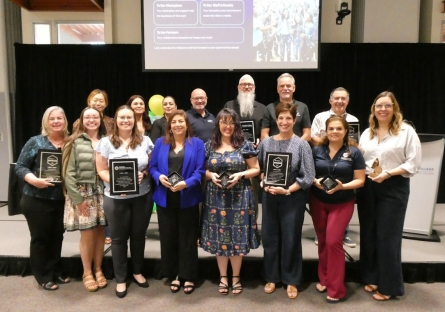
Rio Salado College recently hosted a celebration recognizing the completion of a multi-year effort to design and scale microcredentials across Maricopa Community Colleges with Education Design Lab (The Lab).
Held March 27, the event brought together partners from Rio Salado College, Chandler-Gilbert Community College, Mesa Community College and Scottsdale Community College, as well as Maricopa Corporate College and Maricopa Community Colleges leadership. Glendale Community College joined the initiative later, expanding the impact across the district.
Supported by The Education Design Lab’s Community College Growth Engine Fund, the project focused on creating flexible, skills-based learning opportunities aligned with high-demand industries, including information technology and advanced manufacturing. These microcredential pathways were co-designed with employers, enable students to demonstrate mastery of skills, and result in digitally verifiable skills badges and microcredentials to recognize student achievement. The microcredential pathways lead to family-sustaining jobs while also providing onramps to Maricopa’s existing degree pathways.
“This work challenged us to think differently about how we define and deliver learning,” said Rio Salado Executive Vice President of Strategy and Academic Affairs Janelle Elias. “We wanted to create opportunities that help students build skills and communicate those skills clearly to employers.”
The Maricopa Colleges were selected in Cohort 2 of the Community College Growth Engine Fund initiative in 2022. Since the inception of the fund, more than 90 colleges nationwide have worked with EDL’s design accelerator to create skills-based educational pathways for learners. The goal, according to EDL, was to create, “employer-validated micro-pathways designed to connect low-wage and entry-level workers to in-demand jobs that pay at-or-above median wage and put them on a path toward a degree.”
Building Skills That Translate
At the center of the initiative are digital microcredentials and microcredential pathways — short-term, targeted learning experiences that validate specific skills and stack into additional learning opportunities, such as certificates and degrees. The programs were developed using a human-centered design approach, incorporating feedback from both students and industry partners to ensure relevance and value.
“This approach helps students better understand what they’ve learned and how to apply it,” said Project Manager Sasha Flores. “It also helps employers see the full picture of a candidate’s abilities.”
Results Across the District
Over the course of the project, Maricopa Colleges launched:
- 19 digital microcredentials
- 8 microcredential pathways
- Hundreds of badges awarded across participating colleges
The initiative also established a shared framework for how microcredentials are designed, issued and communicated. A system-wide badging platform and common badging taxonomy now support consistent implementation across colleges.
Programs developed through the project— including IT Fundamentals and Workforce Professional Skills— have already been adopted and expanded at multiple colleges, demonstrating the model’s scalability. In fact, Maricopa County adopted the Workforce Professional Skills training for all employees.
The work laid the foundation for further microcredentials in the field of healthcare - which now shares the taxonomy. The Healthcare team developed 25 microcredentials and two pathways. Already, badges have been awarded to students in areas such as: behavioral research, case management, nonviolence crisis intervention and mental health first aid.
Preparing for the Future of Work
This innovative work positions Maricopa Community Colleges as a national leader in the growing shift toward skills-based learning and hiring. As employers increasingly prioritize demonstrated skills, microcredentials provide a clear and credible way for students to showcase what they can do.
The project also contributed to the development of a Learning and Employment Records (LERs) ecosystem, which allow skills to be digitally verified and securely shared with students and employers. The work continues to scale across nine of 10 Maricopa Community Colleges and laid a foundation for a state-wide Arizona Learning Mobility Collaborative.
“Students are looking for flexible, meaningful ways to build skills,” Elias said. “This work helps ensure we are meeting that need both now and in the future.”
Nearly 6,000 badges have been awarded since this work began.
Learn about the badges available on the website, including:
- IT Fundamentals
- Workforce Professional Skills
- Responsible AI Ethics
- Data Analytics
Many of the badges were built into courses for students to obtain as they work toward their degree or certificate. Others are standalone.
Earn a Digital Badge and Enhance Your Resume
Last fall, Maricopa County announced that all Maricopa County residents are able to apply to earn the Workforce Professional Skills badge through Maricopa Community Colleges. The Workforce Professional Skills microcredential is to help residents build their resumes and learn skills.