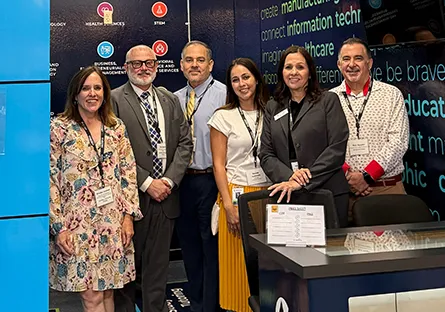
New five-state workforce consortium to accelerate microelectronics training, coordination, and talent development across the Southwest.
Tempe, Ariz., May 28, 2026 – Maricopa Community Colleges has joined government, industry, and workforce leaders in a major new initiative to strengthen semiconductor and microelectronics talent pipelines across the Southwest.
The Arizona Commerce Authority (ACA), in partnership with the National Network for Microelectronics Education (NNME), SEMI Foundation, and the National Science Foundation (NSF), announced the designation of NNME Southwest as an official NNME Regional Node on May 27, 2026. This establishes the region as one of the nation’s anchor hubs for semiconductor workforce development.
“Industry drives everything we do in Arizona, and that’s especially true with the NNME Southwest Regional Node,” said Sandra Watson, President and CEO of the Arizona Commerce Authority. “Our region is home to one of the fastest‑growing and most complete semiconductor ecosystems in the country, powered by world‑class employers, educators, and workforce partners. The ACA is proud to lead this initiative and work alongside our partners across the Southwest to build a scalable, industry‑aligned workforce system that strengthens talent pipelines and supports the continued growth of America’s microelectronics leadership.”
Building a Regionally Anchored Workforce System
The NNME is a national effort designed to strengthen and scale America’s microelectronics workforce development ecosystem. Convened by the ACA, NNME Southwest brings together 47 partners across Arizona, Colorado, New Mexico, Southern California, and Utah. Global technology giants involved in the initiative include Intel, TSMC, Amkor, Micron Technology, Applied Materials, Lam Research, Nikon Precision, Symopsys, Arm, Northrop Grumman, RTX, Teledyne Technologies, HRL Laboratories, among others across the semiconductor sector.
The Southwest Regional Node will focus on scaling coordinated, employer-driven training across the region through aligned curriculum and stackable credentials. It will expand hands-on learning and work-based experiences, such as pre-apprenticeships, internships, and fellowships. Additionally, the initiative aims to strengthen talent pipelines by supporting K-12 engagement and increasing access for rural communities through digital training technologies.
“Arizona has become one of the nation’s most important regions for semiconductor and microelectronics innovation,” said Valerie Jones, Vice Chancellor of Workforce and Economic Development for Maricopa Community Colleges. “Partnerships like NNME Southwest are critical to ensure that our state has the skilled workforce it needs to support the industry’s continued expansion and long-term success. Maricopa Community Colleges is proud to help expand access to high-quality career pathways that are shaping the future of Arizona’s economy.”
Creating Pathways that Work
As a member of the NNME Southwest Regional Node, Maricopa Community Colleges will continue to align its curriculum with employer needs, coordinate career pathways across the semiconductor industry, and expand access to training and hands-on learning. This effort will directly improve recruitment and retention of talent within the industry.
To support the growing talent pipeline, Rio Salado College, one of the 10 Maricopa Community Colleges, supports several industry-aligned programs, including:
- The Microelectronics and Nanomanufacturing Certificate Program, available at Rio Salado College (Rio Salado), is a free 12-week noncredit program launched three years ago through a partnership with Penn State and Arizona State University and funded by an NSF grant. The experience provides students with foundational knowledge, hands-on lab experience, and exposure to industry tools and environments. The fall cohort beings in August. Applications can be found on the MNCP website.
- TSMC Apprenticeship programs at EMCC and Rio Salado provide on-the-job training that aligns with related coursework. Apprenticeships typically last 12-18 months, and students have the opportunity to earn associate degrees and certificates.
- An Associate in Applied Science (AAS) in Semiconductor Manufacturing degree, designed to provide students with the general principles and foundational skills in the semiconductor industry and related manufacturing industries.
- Certificates of Completion (CCL) in Introduction to Semiconductor Manufacturing and Semiconductor Manufacturing are also available. Both provide lessons on manufacturing processes, equipment systems, packaging technologies, quality control methods and the scientific principles
“The Maricopa Community Colleges are honored to be a partner in this regional effort, and we are deeply grateful to the Arizona Commerce Authority and the SEMI Foundation for their vision and investment in Arizona's workforce future,” said Dr. Rick Vaughn, Faculty Chair of STEM Initiatives at Rio Salado College. “We are thrilled to expand these high-quality pathways to students across the district to help meet the growing demand for skilled technicians in Arizona's microelectronics and semiconductor industries.”