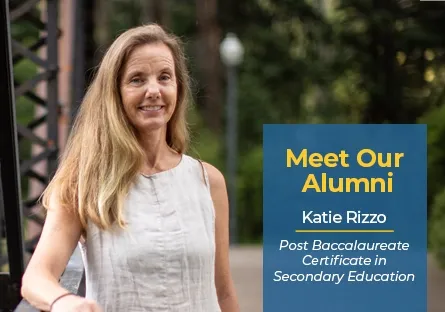
As a society, we often think of STEM and the humanities as separate domains that don’t intersect. One is drawn to the sciences, or to the arts —seldom to both. This is a false dichotomy: some of history’s great inventors were also artists, and many poets, painters, authors, and filmmakers share a fascination for both the natural world and the invisible world of physics and mathematics. Rio Salado alumnus Katie Rizzo has one foot planted in both worlds: She’s a scientist and a poet. She’s also a published author, with a deeply personal work of nonfiction and a forthcoming collection of poetry as part of her body of work.
Released on Oct. 6 by Koehler Books, Rizzo’s The Trimesters of Grief is a moving hybrid memoir and prescriptive guide. In the book, Rizzo talks about the loss of her firstborn son, Nicholas, to opioid addiction in 2024 and how she used the lens of gestation to reframe her grief. Carrying her trauma like a pregnancy, she had to learn how to deliver this “grief baby” in her own way.
“The book started as a journal to myself,” Rizzo said. “When I was trying to find books about losing a child to addiction, I realized I had to write the book I needed. There are very few books on how to survive the loss of your child to addiction.”
Rizzo’s skill as a poet is apparent throughout The Trimesters of Grief; she handles and sets each well-constructed sentence with great care like a jeweler placing small diamonds down on black velvet. The precision of her prose also points to how much her scientific background has molded her style as an author.
“I started my career interested in understanding our human experience through the lens of science,” Rizzo said. “Specifically, how did each of our body systems evolve, and why are they similar and different among species? After the loss of our son, I’ve been learning about our human experience from a more artistic approach. Poetry, storytelling, and visual arts all speak to me on a level that science can’t touch… Science influences my writing, especially my poems. As an artist, it feels like I can look at things under a microscope and then zoom out, looking through a telescope.”
Rizzo’s training in the sciences can be traced back to her early college years. Finishing an undergraduate degree at The University of Denver, Rizzo went on to get a master’s degree in child development/psychology at Yale.
“At Yale, I decided that I needed to lean into the harder sciences and went to the University of Colorado School of Medicine,” Rizzo said.
As the saying goes: Man makes plans while the universe laughs. Rizzo’s career trajectory took an unexpected turn.
“All my professional plans were derailed when I became a mom,” Rizzo said. “My husband, one-year old son Nicholas, and I moved to Arizona. We had two more kids, and I got the honor of a lifetime to stay at home and watch our three kids grow up. Once everyone was old enough to be in school, I enrolled in Rio.”
Rizzo completed the post-baccalaureate program in secondary education at Rio in 2010.
“The post-baccalaureate program in secondary education at Rio is world-class,” Rizzo said. “Not only did I learn the most up-to-date theories and studies on education, but it was at my own pace, and there was a lot of mentoring that I found helpful.”
After graduating from Rio, Rizzo went on to teach at Dobson, Mesquite, and then Highland High School, all in the East Valley. When asked what advice she would give to new students at Rio Salado, Rizzo talked about the importance of connecting with the community.
“Talk to your professors and get to know other people in your program,” Rizzo said. “Even though most of my courses were online, my professors gave great feedback and advice… You get out what you put in. If you want a world-class education, you can get it here; you need to show up early, put the work in, and make connections built on substance and kindness.”
When Rizzo experienced the devastating loss of her son, she sought comfort and understanding by joining grief groups, listening to podcasts, and reading everything she could get her hands on. Rizzo found it hard to find empathetic resources that weren’t influenced by society’s preconceptions about addiction.
“We as a society treat addiction as a problem of willpower, and blame the person for not being
strong enough,” Rizzo said. “There’s a lie we tell ourselves that addicts need to get better control of themselves. Scientifically, if you look at how the brain responds to a substance, it increases the receptors so that the person is unable to have the same baseline happiness. Tolerance means that their baseline is now lower for those neurotransmitters. They are forced to live a life of lower joy and increased anxiety. White knuckling doesn’t work.”
As much a mother’s haunting tribute to her beloved son as it is a compassionate and clear-eyed exploration of how to process grief, The Trimesters of Grief is essential reading for any reader coming to terms with loss or trying to help a living loved one pass through the crucible of addiction.
“My son didn’t want this to be his story,” Rizzo said. “There is so much shame with using substances, and I want this book to contribute to breaking that shame. Nicholas was a beautiful human, and he struggled with breaking free. Eighty thousand others died in 2024 from overdoses in the U.S. That’s equivalent to one commercial jet going down EVERY DAY. When are we going to start seeing addiction as a crisis and treating it with compassion and real solutions?”
Rizzo’s The Trimesters of Grief can be found anywhere books are sold. Her book of poems, None of Them Are You, is out on Nov. 1st.
Article by Austin Brietta