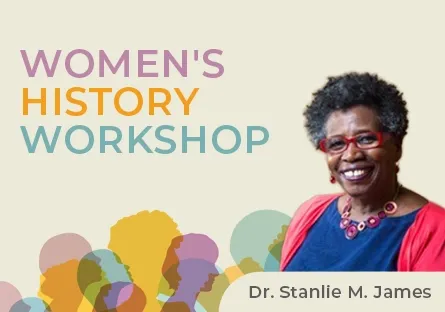
On Tuesday, March 24, Rio Salado College celebrated Women’s History Month with an inspiring virtual event called Practical Audacity: Black Women and International Human Rights. Presented by Rio's CommUNITY Engagement Council, this workshop-style event featured the keen insights and experiences of Dr. Stanlie M. James. Dr. James is an Emeritus Professor of African and American Studies at Arizona State University, with joint appointments in Women and Gender Studies and Justice & Social Inquiry. Her scholarship examines Black women's leadership and situates their vital contributions within international human rights movements.
Dr. James kicked off the workshop by talking about the long and winding professional road that took her from Spellman to the University of London to finally earning her PhD at the University of Denver's graduate school of International Studies. She talked about people who inspired her, like Bernice Johnson Reagon, a founding member of the Black women’s a capella group, Sweet Honey in the Rock, who helped coordinate non-violent actions in the 60s and went on to be a historian at the Smithsonian. She also brought up the shining example of civil rights activist Ella Baker, who James explained was an unsung hero in the movement.
“She’s the one that told Martin Luther King to keep going after they did the Montgomery bus boycott,” Dr. James said. “She and several other people went down and told him you need to organize now so we can get rid of segregation. Because he was thinking that the people needed to sit down and rest, and she said no.”
Dr. James went on to explain how Baker traveled across the South, setting up NAACP chapters so that local communities had their own bases of people power that could act independently and represent the interests of their communities. Baker helped give people the tools to organize themselves so they wouldn’t be reliant on just one top-down group to do it for them, which helped strengthen the overall civil rights movement by not putting all their organizational eggs in one basket.
When asked to define what “practical audacity” meant, Dr. James explained that the 14 women featured in her book Practical Audacity shared a similar out-of-the-box approach to community-building and activism.
“These women looked around themselves and noticed there were issues or problems,” Dr. James said. “And they thought ‘how can I fix this? What can I do? And at the time, you didn’t go to the city council or the Congress because they weren’t going to pay attention to what our issues were. They had to figure out how to address these problems and make it better for whatever the situation was.”
She talked about the labor organizer Sarah White, who fought fiercely against the bigotry, sexual harassment, and hazardous working conditions she and other Black women experienced at a catfish plant.
Dr. James also discussed the importance of intersectionality, and how part of the reason why she’s interested in foregrounding the stories of Black women is that in the past the academy often treated women’s studies as a white women-centered field. The stories of Black feminists- rather than being included in the canon of women’s studies- would often get lumped in with African American studies, even when their narratives and cultural impacts made great strides for women from all backgrounds. She talked about how human rights can get siloed as its own discrete thing when really it’s interrelated to everything: race, gender, economics, war.
When asked how individuals can make a difference in the cause of advancing human rights, Dr. James emphasized the importance of collective action.
“It’s so much better when it’s a shared value,” Dr. James said. “I don’t own this. This is not my work; this is our work. Value working collectively. You are less vulnerable because if it’s just only the people over there that are responsible for doing the work, you can take them out in a minute and the program is gone. But if it is filtered throughout the entire system, that’s much, much more difficult to take out.”
As to what people can do specifically to help, Dr. James suggested that people look to their own skill sets to see how they can help others.
“The artists, they’re gonna do this very differently than the engineers cause the engineers think differently from poets,” she said. “How they attack the problem will come out of who they are.”
Article by Austin Brietta