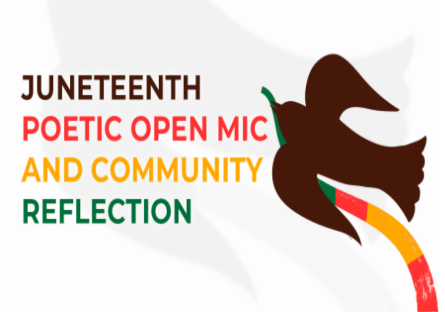
In 2021 the U.S. government made Juneteenth a federal holiday. Juneteenth is on June 19th, commemorating the day that slavery officially ended in the United States when Union army troops liberated more than 250,000 enslaved Black Americans in Galveston, Texas. Rio Salado College marked this important day of recognition this year with an open mic virtual event on Tuesday, June 16.
Moderated by Reina Ferrufino, Rio Salado College's Program Officer of Community Engagement, the Juneteenth Poetic Open Mic & Community Reflection event brought together Rio faculty, staff, students, and community members to share their thoughts and art. In true open mic spirit, the event was headlined by two featured poets from the Rio family: Senior Development Officer Janine McGhee and Student Services Specialist Min Yve-Louise.
Ferrufino opened the event by sharing seven group norms for participants:
- Listen with care and curiosity
- Honor lived experiences
- Lead with empathy
- Learn with humility
- Practice shared spaces
- Speak from the heart
- Ask with openness
The group was prompted with the question of what Juneteenth means to them. Many spoke about how it’s a celebration of Black independence. Yve-Louise pointed out how sobering it is to consider the large temporal gap between the abolition of slavery in 1863 and Juneteenth finally getting formally recognized as a holiday in 2021. As far as we’ve come as a country, she noted, it still took a long time to celebrate such an important milestone in our collective history.
Yve-Louise read a poem about chattel slavery, celebrating the freedom of liberated slaves while remembering “the cries of those unheard ”—the countless Africans lost to time and memory, who either died during the inhuman crossing of the Atlantic in slave ships or perished in chains on American soil, the orphans and broken families torn away from each other by a brutal system of oppression. It was that system Yve-Louise addressed in her poem, talking about the ways laws were used to repress slaves and make other Americans complicit in the slave trade: “because it was written in the language of the oppressers it must be true.”
After McGhee read a thoughtful poem that wrestled with the idea of legacy (“what will your legacy be?”), the open mic audience received a 10-minute break to find thoughts to share with each other. These readings included this stirring quote by poet Maya Angelou: “My people had used music to soothe slavery’s torment or to propitiate God, or to describe the sweetness of love and the distress of lovelessness, but I knew no race could sing and dance its way to freedom.”
Several participants cited poet and activist Amanda Gorman’s “The Hill We Climb.” The music of Bob Marley, gospel singers, and soul musicians were also invoked during this freewheeling conversation.
While this event lasted only an hour, there was enough food for thought served up at this communal table to keep the community well-fed for days afterward.
Learn More About Juneteenth
Want to learn more about Juneteenth? The Rio library staff have put together an informative guide full of articles, videos, and even links to podcasts offering plenty of historical context and perspectives on what Juneteenth celebrates and why continuing to honor this day year after year is so important.
Article by Austin Brietta