Body
Introduction
The first assessment plan at Rio Salado College (RSC) was implemented in 1991. Since then, ongoing assessment initiatives aimed at increasing student learning have continued to demonstrate evidence of RSC’s central focus on this work. Student learning outcomes are measured in five core areas: Critical Thinking, Information Literacy, Oral Communication, Social Responsibility, and Writing. These outcomes are assessed at the college level, the program level (as part of Program Review), and via the continuous improvement Plan-Do-Check-Act (PDCA) cycles at the course level. Collectively, these efforts provide a solid infrastructure for assessing and increasing student learning at RSC.
Over the years, RSC’s assessment plan has progressed from a static document that was reaffirmed on a periodic basis, to a dynamic, ongoing, and evolving series of activities that are integrated across the teaching and learning spectrum. The Learning Assessment Team includes representation from Faculty Chairs, Senior Administration, and Institutional Research, and has responsibility for coordinating all aspects of student learning assessment.
RSC maintains a public Assessment of Student Learning website so that the institution’s assessment data and processes are transparent and available to all stakeholders.
Overview
During AY20 25-26 , Student Learning Outcomes (SLO) - focused work has continued in the areas of Critical Thinking, Information Literacy, Oral Communication, Social Responsibility , and Writing . Of particular note for this reporting cycle was the integration of digital literacy competencies into the information literacy SLO and a PDCA cycle designed to improve the rubrics for each of the college-wide outcomes.
Program review has proceeded as scheduled, with four programs undergoing the review process during AY 2025-26.
W ork to improve both online instruction and assessment has been ongoing throughout the year based on insights from the Dynamic Assessment Data Display (DADD). The data demonstrate that RSC students taking online classes met or exceeded the 80% college-level threshold in four of the college’s five institutional student learning outcomes (including Social Responsibility, which was formally incorporated into the DADD during AY2025-26).
PDCA improvement cycles are a required component of the College’s program review template. Selected examples are included in this report.
Additional d etails on each of these initiatives are provided below.
Student Learning Outcomes Work
Rio Salado College is committed to the assessment and improvement of the following college-wide Student Learning Outcomes:
- Critical Thinking
- Information Literacy
- Oral Communication
- Social Responsibility
- Writing
During AY2025-26, nearly 2.0 million online subjective assessment items were assessed by RSC faculty. Over 80% of these subjective items (1,817,071) were directly linked to one or more college-wide student learning outcomes. Overall, 82.8% of these items were assessed as being at or above college-level. The table below shows student performance disaggregated by learning outcome for assignments submitted during 2025-26.
Assignments at College Level by Learning Outcome
| Student Learning Outcome | Assignments Submitted | Assignments at College Level | Percentage of Assignments at College Level |
|---|---|---|---|
| Critical Thinking | 572,836 | 466,140 | 81.4% |
| Information Literacy | 344,896 | 282,350 | 81.9% |
| Oral Communication | 31,094 | 24,656 | 79.3% |
| Social Responsibility | 44,362 | 37,066 | 83.6% |
| Writing | 679,879 | 556,054 | 81.8% |
| Total | 1,817,071* | 1,504,307 | 82.8% |
*Since some assessment items are linked to multiple student learning outcomes, this total is higher than the distinct number of assessment items evaluated.
The data demonstrate that RSC students t aking online classes met or exceeded the 80% college-level threshold across four of the college’s five college-wide student learning outcomes: Critical Thinking, Information Literacy, Social Responsibility, and Writing. Student performance on assignments linked to the Oral Communication outcome fell just short of the college's 80% threshold in AY2025–26, with 79.3% of students meeting the college-level benchmark. While this result indicates an opportunity for improvement, it also reflects ongoing efforts to assess oral communication skills across online courses.
During the academic year, the Oral Communication Student Learning Outcome Coordinator continued collaborating with Faculty Chairs to expand both the variety of instructional materials that support oral communication and the number of assignments intentionally aligned with this outcome across academic departments. These efforts are intended to increase students' opportunities to practice and demonstrate oral communication skills in authentic disciplinary contexts while strengthening assessment of the outcome across the curriculum.
The following Plan-Do-Check-Act (PDCA) cycle illustrates one example of how assessment findings informed instructional improvements intended to strengthen student performance in oral communication.
PDCA: Oral Communication in the Health Sciences Department (Cycle 2)
Plan: In Fall 2023, the Health Sciences Department noted that none of the assessments in HCR healthcare courses included oral communication. The HCR prefixes are highly-enrolled courses that serve the Nursing Start program and are required in the AA, Emphasis in Community Health, both fields in which it is critical to have effective oral communication skills.
Do: In Spring 2024, the Mid-Term Projects in HCR220 and HCR230 were redesigned to include oral components, with the updates deploying in new course versions dated 10/14/2024. In Fall 2024, the Lesson 10 Assignment in HCR240 was redesigned to incorporate an oral component in the updated course version that rolled out 4/28/2025.
Check: Cycle 1 data from AY2024-25 indicated that the target was met for HCR220 and (practically) met for HCC230.
| Course | # of Submissions | % at College Level |
|---|---|---|
| HCR220 | 55 | 83.6% |
| HCR230 | 54 | 79.6% |
| HCR240 | 7 | 71.4% |
Though results for HCR240 fell short of the target, there were very few data points at that time, and the decision was made to pull results again at the end of AY2025-26 before implementing any further interventions. The table below reflects data as of 7/22/26.
| Course | # of Submissions | % at College Level |
|---|---|---|
| HCR220 | 131 | 83.0% |
| HCR230 | 285 | 78.2% |
| HCR240 | 389 | 86.9% |
Act: Since Cycle 2 results for HCR220 continue to meet the target and results for HCR240 now exceed the target, interventions are not planned for those courses at this time. While results from HCR230 are slightly below the target, they align with overall college-wide data for Oral Communication. This learning outcome will continue to be monitored during AY2026-27 and a new PDCA cycle will be initiated for HCR230, if needed.
PLAN-DO-CHECK-ACT Cycles (PDCA)
In keeping with RSC’s ongoing focus on relentless improvement, below are additional examples of PDCA cycles that were initiated and/or completed in 2025-26.
PDCA: Information & Digital Literacy Rubric
PLAN: In AY2024–2025, the Assessment Team began exploring ways to incorporate digital literacy into Rio’s college-wide student learning outcomes.Approaches used by other colleges and universities were reviewed, as were current digital literacy frameworks. The team also consulted with Rio’s computer technology faculty chair. During AY2025–2026, the information literacy coordinator proposed integrating digital literacy into the existing Information Literacy outcome as a holistic way of assessing student’s ability to locate, evaluate, use, and create information while also maintaining a streamlined and sustainable assessment team structure. The information literacy coordinator drafted a revised Information & Digital Literacy outcome and accompanying rubric.
DO: The draft outcome and rubric were shared with the computer technology faculty chair for review and feedback. Following their support of the proposed revisions, the draft was presented to the Assessment Team. Team members reviewed the materials and recommended minor revisions to improve clarity and applicability across disciplines.
CHECK: The revised Information & Digital Literacy outcome and rubric were presented to the faculty cohort for input, review, and approval. Faculty approved the changes in Spring 2026.
ACT: Following faculty approval, the updated rubric material was published on the college website and the supporting LibGuide was revised to reflect the changes.
PDCA: Student Learning Outcome Rubrics
A Rio faculty chair noted that the existing performance level labels (4,3,2,1) on each of Rio’s college-wide rubrics could be interpreted as corresponding to specific course grades (A,B,C,D). Concerns were also raised that the separate statement included on each rubric that defined ‘college-level’ performance as 70% or higher could create confusion.
PLAN: The Assessment Team’s Student Learning Outcome Coordinators reviewed the concerns to determine appropriate revisions. Because the college-wide rubrics are intended to guide assessment of student learning outcomes rather than prescribe specific grading practices, the group agreed to revise the rubric templates.
DO : The numerical performance level labels (4, 3, 2, 1) on each of the rubrics were replaced with descriptive categories: High-Level, Competent, Minimally Acceptable, and Unacceptable . The statement defining college-level performance as 70% or higher was also removed from the rubric templates.
CHECK: Proposed rubric revisions were presented to the broader faculty cohort for input and approval. Faculty approved the changes in Spring 2026.
ACT: Following faculty approval, the revised rubric templates were published on the college website and associated LibGuides, which are accessible via the expanded content for each learning outcome on the linked page.
PDCA: ACC221 (Tax Accounting)
PLAN: During the last program review, data revealed that from AY2020-24, only 45% of students performed at a college level for the ACC221 Lesson 6 Case Study, which is associated with the following program-level outcome:
10. Demonstrate an understanding of compliance in accounting, reporting and tax .
DO: For the ACC221 Lesson 6 Case Study, students calculated partnership interest over two years and identified which items belonged on page 1 of the partnership return. In July of 2025 the case study was revised to focus more on how partnership interest is affected by income, deductions, and liabilities, with added attention to the differences between limited and general partners. In addition, Part 2 now asks students to determine the tax treatment for each partnership transaction rather than simply placing items on a return. These updates simplify the case study while ensuring students still gain a clear understanding of separately stated items and how partner liability differs depending on their role.
CHECK: Data from 7/7/2025-6/30/2026 indicate that at least 90% of students who submitted the revised Lesson 6 Case Study were rated at a college level.
ACC221 Lesson 6 Case Study
| Rubric Dimension | Assignments Submitted | Assignments at College Level | Percentage at College Level |
|---|---|---|---|
| Critical Thinking/Analysis | 40 | 37 | 92.5% |
| Mathematical Calculations | 40 | 36 | 90% |
| Understanding | 40 | 36 | 90% |
ACT: Student performance on the revised assessment exceeded the goal, and the structure of this case study is being used as a template for future course and assessment modifications.
PDCA: AJS260 (Procedural Criminal Law)
PLAN : Lesson 1 in AJS260 is associated with the following program-level learning outcome:
4. Communicate in the language common to the criminal justice system.
Data from the DADD indicated that student performance on the Content dimension of the grading rubric for the AJS260 Lesson 1 assignment exceeded the goal, as 85% of students performed at a college level. However, only 53% of students performed at a college level on Mechanics & Formatting and 68% on Organization, both of which did not meet the goal.
DO: As this is the first assignment of the course, students may not fully understand expectations for APA formatting. To help mitigate this, instructions were modified to provide examples and additional guidance regarding the expectations for college-level writing for this assignment. The new instructions are as follows:
Write an essay addressing the topic below. Your essay should be 500 to 750 words, 2 to 3 pages (not including cover page and reference page), double-spaced, with a font size of 10 to 12 pt. Your paper should comply with APA 7th Edition (student paper version). A sample can be found here: APA Sample Papers . Refer to the Grading Rubric PDF (linked in the lesson) for essay grading standards.
CHECK: Data from Spring flex 2 (3/9/26) through 6/30/26 indicate that the goal was now met for two of the three rubric dimensions.
AJS260 Lesson 1 Essay Assignment
| Rubric Dimension | Assignments Submitted | Assignments at College Level | Percentage at College Level |
|---|---|---|---|
| Content | 12 | 10 | 83.3% |
| Mechanics & Formatting | 12 | 9 | 75% |
| Organization | 12 | 10 | 83.3% |
ACT: The curricular enhancement correlated with a notable improvement in the percentage of students performing at a college level in both the Mechanics & Formatting (from 53% to 75%) and Organization (from 68% to over 83%) dimensions. Though student performance on the Mechanics & Formatting dimension still fell a bit short of the goal, there were only a limited number of assessment submissions for this review period. Results will be pulled again at the end of AY2026-27 so more data points will be available to evaluate the effectiveness of the intervention.
PDCA: HUM201 (Humanities: Universal Themes)
PLAN: Data from AY2024-25 indicated that only 76% of HUM201 students performed at a college level on the following General Education program-level outcome, which fell just short of the college-wide goal:
On a written assignment, the student will demonstrate the ability to generate relevant and sufficient content; organize their thoughts coherently; adhere to the conventions of correct mechanics and sentence structure; and use correct terminology and rich vocabulary in the fulfillment, at the college level, of their writing assignments.
DO: The review noted that, even though the assessments are quite complex, students are not required to have taken any writing courses prior to enrollment. As a result of undergoing the review process, the HUM201 essays in the new October 2025 course version were modified to build on one another, thus developing the students’ writing skills along the way. Specifically:
- Lesson 1, Writing Assignment #1 was modified to eliminate the expository requirement and include a different set of requisite points
- Lesson 5, Writing Assignment #2 is now more personalized and it incorporates individual experience, drawing on more life knowledge to make it relatable to the student. Changes were made to the scoring rubric.
- Lesson 10, Writing Assignment/Project #4, like #2, has been altered so the student has more choice regarding how points are conveyed. Instead of just an essay, information can be presented through a different medium to allow for more digital learning and creativity with personal experience. Minor scoring rubric changes were made.
CHECK : Post-intervention results from 10/20/2025-6/30/2026 indicate that 89.7% of HUM201 students performed at a college level on the identified program learning outcome.
ACT: The goal has been met, and the transition to more scaffolding and personalized content for writing assignments is being incorporated across the General Education curriculum.
PDCA: Social Responsibility in Health Sciences
PLAN: A goal for the Health Sciences department was to more broadly integrate the new Social Responsibility outcome, which is particularly relevant to healthcare-related courses.
DO: HCR230 (Culture and Health) was revised 08/2024 with Social Responsibility incorporated in Lesson 3 Assignment and FON241 (Human Nutrition) was revised 01/2026 to incorporate Social Responsibility in the Lesson 12 Assignment.
CHECK: HCR230 results from 8/2024-7/2026 indicate that almost 93% of the students performed at a college level for Social Responsibility on the Lesson 3 Assignment.
In contrast, data from 1/2026-7/2026 indicate that only about 66% of students performed at a college level for Social Responsibility on the Lesson 12 Assignment in FON241.
ACT: Data from HCR230 met the college-wide target, so no further intervention is planned. FON241 results fell well below the goal, and a new PDCA is being initiated for AY2026-27.
Assessment Reporting
Faculty have a variety of data and reporting resources available to monitor assessment of student learning. One of those tools, RSC's Dynamic Assessment Data Display (DADD), is a web-based dashboard used by Faculty Chairs to monitor student performance on assessment items. The DADD enables faculty to identify areas where students are not performing at desired levels and evaluate the effectiveness of curricular and instructional improvements over time.
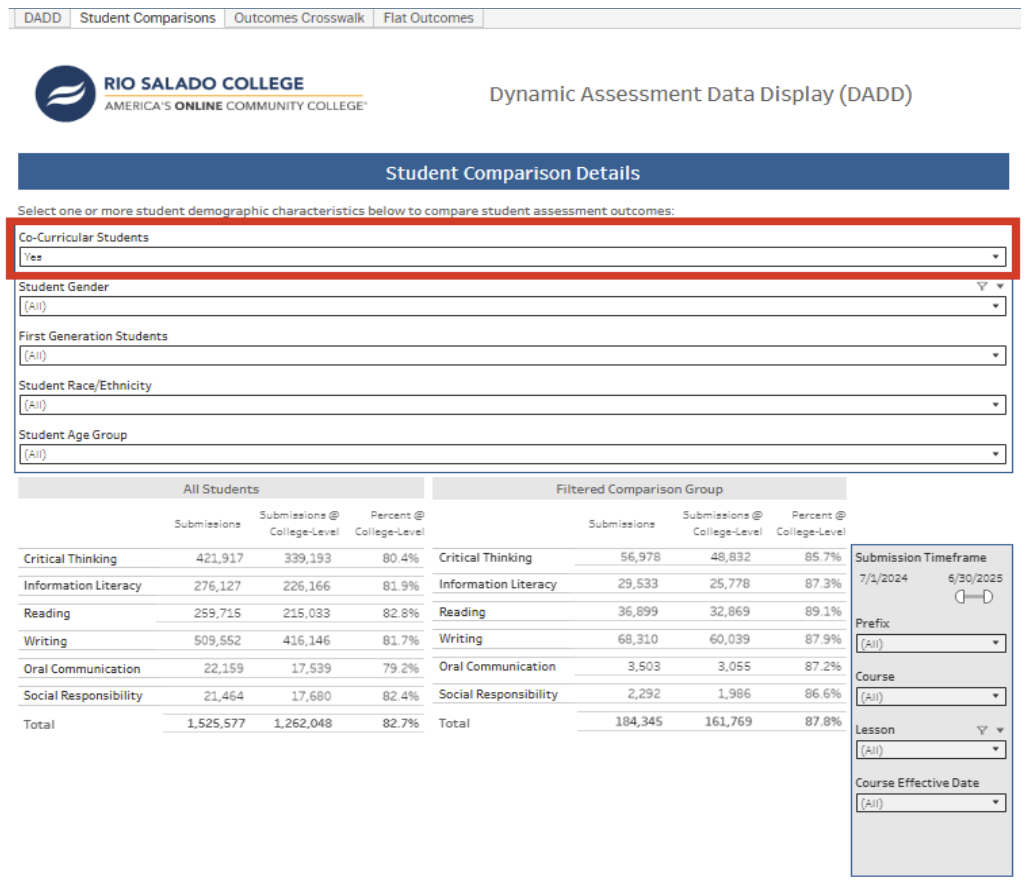
Building on enhancements outlined in last year’s annual report , additional functionality was incorporated into the DADD during 2025-26 to expand the college's ability to analyze assessment outcomes across student populations. A new peer comparison view was developed that allows users to segment assessment results by key demographic and student characteristics, making it easier to compare outcomes among populations such as co-curricular participants, first-generation college students, and other student groups. These enhancements provide faculty with greater insight into differences in student learning outcomes across populations and support more targeted, data-informed conversations about instructional improvement and student success.
Expansion of the college’s new rubric dimension tagging framework, first introduced in 2022-23 , continued in 2025-26 to include more assessments. This new process more clearly articulates the alignment between course assignments and activities to Rio’s college-wide student learning outcomes, and significantly improves the ability to report assessment outcomes while alleviating the need to maintain manual crosswalks. The proliferation of this tagging method resulted in 2,202 new rubric items being included in the process, and is now reflected in nearly one-half of all assessment rubric dimensions in online courses:
| Dimension-Tagging Method | 2023-24 | 2024-25 | 2025-26 |
|---|---|---|---|
| New Bracketed Method | 5,411 (25.5%) | 7,767 (35.9%) | 9,969 (45.9%) |
| Legacy Crosswalk Method | 15,846 (74.5%) | 13,861 (64.1%) | 11,754 (54.1%) |
Co-Curricular Student Assessment
RSC’s DADD reporting provides faculty with the ability to compare all student performance on course assignments with those submitted by students engaged in co-curricular programming. For this purpose, co-curricular programming is defined and incorporated into the DADD as Honors, Adult ACE & Phi Theta Kappa students as well as well as students enrolled in courses with experiential learning opportunities, including Addictions and Substance Use Disorders, Social Work, and Educator Preparation internship courses. Data from FY2025-26 indicate that co-curricular students outperformed the general student population on assessment activities across all five college-wide student learning outcomes.
Co-Curricular (CC) Assignments at College Level by Learning Outcome
| Student Learning Outcome | Number of Assignments Submitted by CC Students | Number of CC Student Assignments at College Level | Percentage of CC Student Assignments at College Level | Percentage of All Student Assignments at College Level |
|---|---|---|---|---|
| Critical Thinking | 72,461 | 62,459 | 86.2% | 81.4% |
| Information Literacy | 30,167 | 26,516 | 87.9% | 81.9% |
| Oral Communication | 4,630 | 4,094 | 88.4% | 79.3% |
| Social Responsibility | 2,731 | 2,403 | 88.0% | 83.6% |
| Writing | 81,607 | 72,036 | 88.3% | 81.8% |
| Total | 195,145 | 171,377 | 87.8% | 82.8% |
More assignments will be added to the co-curricular reporting structure as the college continues to expand internship, practicum, volunteer, and other experiential learning opportunities.
Dual Enrollment
Rio Salado College regularly assesses teaching and learning in courses offered for dual enrollment.
- Course syllabi, including competencies and assessment methods, are reviewed and approved by college faculty for every section taught.
- During AY2025/26, the College continued to standardize its process for collecting assessment samples from dual enrollment faculty to ensure alignment with course competencies. This effort included incorporating standard operating procedure information into the faculty manual. During this academic year, 204 assessment samples from dual enrollment instructors were reviewed by Faculty Chairs or their designees to ensure alignment. Samples are collected from all new instructors and from all instructors whenever course competencies are revised. Work is ongoing to create a permanent repository for this information within the College’s Syllabus Builder tool.
- Instructor evaluations, which are conducted at least annually, provide evidence that dual enrollment instructors are meeting or exceeding college-level expectations for instruction. For example, in AY2025-26, 84% of dual enrollment instructors achieved an “Effective” rating in the “Assessment and Adjustment” category for their peer evaluations.
- Dual Enrollment students were included in the Fall 2025 administration of the E-Proficiency Profile detailed below.
E-Proficiency Profile (EPP)
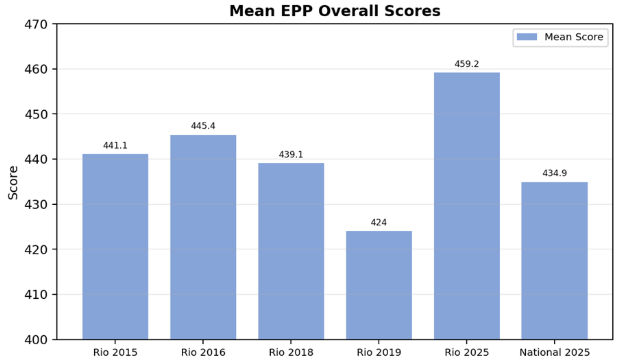
RSC administered the E-Proficiency Profile (EPP) during Fall 2025 as one component of the college's institutional assessment of student learning. The EPP is a nationally standardized assessment that measures college-level achievement in the areas of Critical Thinking, Reading, Writing, and Mathematics as well as breakdowns across select academic content areas of Humanities, Social Sciences, and Natural Sciences. EPP provides an externally validated measure of general education outcomes and allows RSC to compare student performance with national peer benchmark data. During the Fall 2025 administration, 36 students completed the assessment, representing participants from co-curricular learning experiences and dual enrollment programs. These student populations were intentionally selected and should not be considered representative of the college's overall student population.
Overall, RSC participants performed above the national comparison group across the major assessment domains included in EPP. The college's mean overall score was 459.2, exceeding the national institutional average by 24.3 points. Participants scored above national averages learning outcomes of Reading, Critical Thinking, Writing, and Mathematics, as well as the academic content areas. Reading represented the strongest overall performance, and Mathematics demonstrated notable improvement when compared to RSC's prior administration of similar assessments. Critical Thinking was the lowest-performing outcome for RSC participants, but proficiency rates still exceeded peers.
The Fall 2025 administration also provided an opportunity to compare outcomes across two targeted student populations. Co-curricular and dual enrollment participants demonstrated comparable levels of achievement, with only minor differences across skill areas. Even though the sampling approach limits generalizability to the broader student population, the results provide valuable external evidence that complements RSC's course-, program-, and college-wide assessment reporting.
District-wide Assessment
The Maricopa Assessment Committee (MAC) convened monthly throughout AY2025-26 and Rio’s Assessment Team co-chairs served as the College’s representatives. The group discussed annual reporting practices, the District’s Academic Planning Steering Team work, and provided recommendations to RFACT tied to the inclusion of assessment practices within Article 18 of the RFA. MAC monthly meetings continue to provide Rio with the opportunity to learn more about its sister colleges’ assessment practices. Pertinent information from MAC meetings was shared with Rio’s Assessment of Student Learning team during its monthly meetings.
In February of 2026, the Committee was named the inaugural recipient of the Constellation Award from Embry-Riddle Aeronautical University and the Continuous Improvement Summit. The award recognizes groups that excel at organizational alignment by bringing diverse areas of the institution together to create a cohesive, high-performing organization.
Program Review
Rio Salado College has adopted an iterative formal academic Program Review process that is systematic, comprehensive, sustainable, and designed to promote and foster trust among all stakeholders. Every review contains the same foundational components, including program goals, student learning outcomes, program resources, and co-curricular outcomes, which are addressed by utilizing a template of foundational questions and data sets. The faculty Program Review Coordinator works closely with the Program Chair, identifying best practices, areas for improvement, and recommendations through the template, with feedback for future actions. Once the draft is complete, Learning Assessment Team members meet with the Program Chair to discuss the review. The Chair has an opportunity to make any requested edits before the final review is submitted to the Vice President of Academic Affairs for final action. Once the evaluation cycle has been completed, the review is posted to the RSC public Assessment of Student Learning website .
The following programs participated in the review process for AY2025-26:
- Construction Electrician (IRE)
- Early Childhood Education ( ECE Management/Admin & Child/Family Org Mgmt/Admin)
- Information Technology and Web Design
The following programs are anticipated to participate in the review process for AY2026-27:
- Addictions & Substance Use Disorders
- General Education
- Workforce Re-entry (IRE)
- Organizational Management
- Quality Customer Service (IRE +)
- Paralegal
- Risk Management and Insurance Studies
- Teacher Education Elementary Post Baccalaureate (Use ADE approval process documents)
During 2025-26, the Learning Assessment Team partnered with the RSC’s Web Accessibility Taskforce to modernize the program review reporting process in preparation for upcoming changes to Web Content Accessibility Guidelines (WCAG) requirements. As part of this collaborative effort, the team adopted a new, fully accessible program review template developed in Google Docs to ensure that program review documents provide an inclusive and accessible experience for all users.
In addition to implementing the new reporting template, the Learning Assessment Team collaborated with the college's web team to redesign the process used to publish completed program reviews to the college's public Assessment of Student Learning website. Rather than posting program reviews as PDF documents, reports are now published directly from the accessible Google Docs format, improving accessibility while maintaining transparency of the college's assessment and continuous improvement activities. These changes position the college to meet evolving web standards while providing a more usable and inclusive access for faculty, staff, students, and members of the public.
Curriculum and Outcome Mapping
During AY2025/26, the Assessment Team continued supporting department chairs as they mapped program learning outcomes within their courses in preparation for program review. During the College's Year 4 Higher Learning Commission (HLC) Assurance Review, reviewers noted that descriptions of the assignments and assessments mapped to program-level outcomes could provide greater detail about what students are asked to do. In response, the Assessment Team will enhance future program reviews by including more comprehensive descriptions of mapped assignments and assessments, strengthening documentation of how student learning is demonstrated at the program level.
During AY2025–26, Rio Salado’s pilot partnership with the American Association of Collegiate Registrars and Admission Officers (AACRAO) and Credential Engine transitioned from implementation to ongoing use. The mapping of Rio's course competencies and program-level learning outcomes to Credential Engine's registry was completed, helping to connect students' academic learning with workforce-relevant skills. Student adoption of the iQ4 Digital Achievement Wallet remained limited during this reporting year, with approximately 100 students using the platform. While participation was lower than anticipated, the completed competency and learning outcome mapping establishes an important foundation for future efforts to help students identify, articulate, and communicate the skills they develop through their coursework.
Significant Accomplishments in Learning Assessment Work, 2025-2026
- RSC students taking online classes met or exceeded the 80% college-level threshold in Critical Thinking, Information Literacy, Social Responsibility, and Writing.
- The College’s Information Literacy Student Learning Outcome was updated to incorporate Digital Literacy.
- A PDCA cycle was leveraged to update each of the five Collegewide Student Learning Outcome rubrics.
- Working with IA, the process for publishing program reviews and other documents to the public Assessment of Student Learning website was redesigned to improve accessibility, usability, and transparency.
- Four programs engaged in the Program Review process.
- DADD reporting was updated to include a new peer comparison view allowing users to segment assessment results by key demographic and student characteristics and providing faculty with greater insight into differences in student learning outcomes across populations
- Learning outcomes assessment was discussed at t he 2 7th Annual All-Faculty Depart ment Meetings (held virtually during Fall 2025). 404 adjunct faculty members were awarded professional development certificates for attendance.
- RSC’s HLC Year Four Open Pathway Assurance Argument was submitted in February of 2026. The College received notice in March of 2026 that it successfully completed the review with no recommended monitoring.
- Five Outstanding Adjunct Faculty members were recognized for Contributions to Assessment of Student Learning at the in-person Outstanding Adjunct Faculty Reception held in October, 20 25 .
- RSC adjunct faculty completed 166 Adjunct Faculty Development (AFD) workshops during AY2025-26.
- The 2025-26 Learning Assessment Report was compiled and posted to the RSC public website for access by all internal and external stakeholders .
Learning Assessment Team Members, 2025-2026
Dr. Julie Cober , Faculty Chair, Oral Communication Student Learning Outcome Coordinator
Janelle Elias , Vice President of Academic Affairs
Dr. Angela Felix , Faculty Chair, Social Responsibility Learning Outcome Coordinator
Zach Lewis , Associate Dean, Institutional Research, Learning Assessment Team Co-chair
Dr. Miguel Lucas , Dean of Academic Affairs
Dr. Karol Schmidt , Dean, Institutional Effectiveness & Innovation
Dr. Jennifer Shantz , Faculty Chair, Writing Student Learning Outcome Coordinator
Beth Siwek , Faculty Chair, Critical Thinking Student Learning Outcome Coordinator
Sarah Stohr , Faculty Chair, Learning Assessment Team Co-chair, Information Literacy Student
Learning Outcome Coordinator
Dr. Heather Tyler , Dean, Instruction and Workforce Partnerships
Omar Williams , Planning Research Analyst Sr.