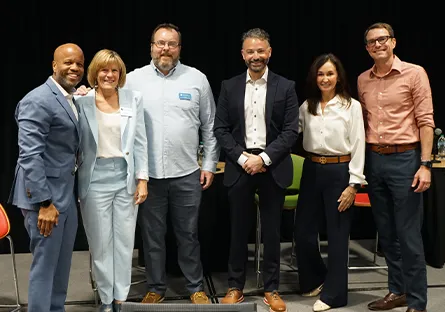
Corey Woods, Kate Smith, Ken Wilk, Zach Mannheimer, Robin Arredondo-Savage, Eric Cylwik
By Mira Radovich, Senior Contributing Writer
Construction, government and education leaders gathered at Rio Salado College on April 30 for “Innovating the Future of Affordable Housing,” a panel discussion about housing affordability, construction innovation and workforce development hosted in partnership with the Tempe Chamber of Commerce.
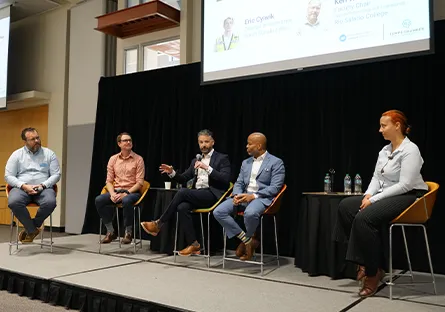
The panel featured Tempe Mayor Corey Woods; Zach Mannheimer, founder and chairman of Alquist 3D; Eric Cylwik, director of innovation for Sundt Construction; Ken Wilk, Rio Salado College faculty chair of applied technology and engineering; and Camryn Sanchez, senior field correspondent for KJZZ, who moderated the discussion.
Woods began the conversation by discussing how the lack of affordable housing impacts school districts.
“There is definitely a huge housing affordability crisis not only across the state, but across the country,” he said. “I have regular conversations with the three superintendents for the City of Tempe. … One of biggest things they talk about is that Tempe is getting so expensive that it’s very hard to recruit and retain teachers. You’ve got teachers teaching in Tempe schools who live way out in the West Valley.
“The challenge is, you’re spending an hour in the car each way going to work and going from work.”
That leads to frequent teacher turnover.
“That has a way of destabilizing our K-12 education system when you can’t attract teachers or you cannot retain them,” he said.
Cylwik, director of innovation for Sundt Construction, then addressed the need to differentiate housing in the community.
“The problem is not just, ‘Can I live in the City of Tempe?’ It’s, ‘Can I live and work and contribute and be a part of the city? Can my kids go out and play with other people’s kids?’” he said.
Sanchez then asked Cylwik about the costs of housing.
“Affordable housing sounds like what you’re asking for is an inexpensive place to live,” he said.
But Cylwik said it’s not the case because the same electrician and equipment operator work on various types of projects.
“If we’re going to put up lights and flooring, those costs are pretty fixed,” he said. “Ultimately, the cost of developing something isn’t just the cost of construction; it’s the net impact of the development on the life of the community it exists in.”
Construction Workforce Impact
Panelists also discussed workforce challenges facing the construction industry.
“The biggest issue is there is a labor shortage,” Cylwik said. “Construction companies are literally not bidding on jobs because they can’t guarantee they will have the workers to deliver the project.”
Mannheimer, whose company Alquist 3D prints concrete walls, said education is one of the keys to innovating affordable housing.
“We’re sitting in the room where this begins,” Mannheimer said. “This is where it happens.”
Alquist 3D began in 2018 and prints houses and commercial buildings using robots.
“That’s cool. It’s fun. People want to come out to see it,” he said. “But the underlying piece of this is a workforce development opportunity with this technology. That is why I am excited to be here discussing this at Rio Salado College.”
Mannheimer’s company focuses on exterior walls. But the construction world still needs electricians, plumbers, carpenters, roofters and HVAC workers.
“There are massive shortages, not just here in Tempe, but across the country,” he said.
Wilk said Rio Salado is exploring ways to meet workforce needs including partnerships, such as one in development with Alquist 3D. The efforts will include local schools and construction companies.
“The big thing we’ve put into practice at Rio is the model we’ve built with industries to assess the needs for employment opportunities,” Wilk said. “We take those strategic partnerships, look at the skills needed for the job, and figure out how we can create training for those skill sets.”
Public Communication and Perception
When asked about issues that arise with affordable housing, Woods mentioned his experience meeting with residents as a city mayor.
“Public pushback can be a challenge,” Woods said. “There is a perception about what affordable housing is and who lives there. People are concerned about traffic and neighborhood aesthetics. We need a better way of framing these issues to residents and community members.”
Mannheimer said there should be a nationwide effort to rebrand the term.
“You said it yourself,” Mannheimer said to Woods. “It should be called ‘attainable housing,’ not ‘affordable housing.’ It is just housing. We are building houses for people to live in our community.”
Cylwik agreed.
“In reality, construction is what it is. It is a product that we produce for people,” he said. “You have to think about how you are developing the community, not just a house.”
Woods said he’s talked to mayors and council members across the country who face similar issues with housing and a community that does not want change.
“We have to find a way as elected officials or city staff to better explain what we’re trying to do,” he said. “We have to have adequate housing stock for people moving here today and in the future.”