By Mira Radovich, Senior Contributing Writer
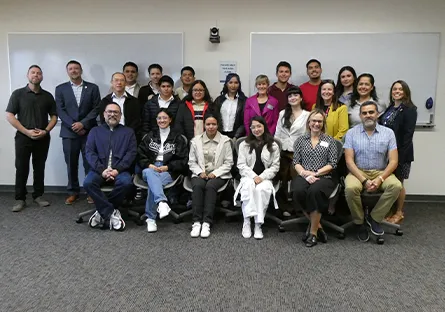
Rio Salado College welcomed students from the Universidad de Guanajuato and Universidad de Sonora (UNISON) in Mexico Feb. 23–27, 2026, as part of a growing international partnership focused on water sustainability and workforce development.
The weeklong visit, coordinated through the Maricopa Community Colleges, highlights Rio Salado’s leadership in expanding cross-border educational opportunities and preparing students to address critical issues affecting Arizona and Mexico.
The visit began with a welcome breakfast and introductory meeting at Rio Salado, setting the tone for a week centered on collaboration, innovation, and shared learning.
“Water is life,” said Danny Fisher, Dean of Manufacturing, Industrial Technology, and Trades at GateWay Community College (GWCC). “We are excited to foster this program, which is a unique partnership and one of only a few in existence.”
Building a Binational Workforce
The exchange program began in 2017 as a grant-funded partnership between GWCC and the Universidad de Guanajuato. Designed to strengthen students’ technical skills, the initiative also enables faculty in both countries to enhance their curricula and better prepare graduates for careers in the water industry.
Rio Salado College plays a key leadership role in expanding this work through its involvement with the Arizona-Mexico Commission’s Education Committee, which is co-chaired by Rio Salado College President Kate Smith.
“The focus of the education committee is to prepare a workforce of the future with a global mindset— to address the pressing needs of local communities and industries such as water sustainability issues— here in Arizona, Sonora, and around the world,” said Smith. “We do that by collaborating with educators and employers to help learners with industry-aligned learning and cross border experiences that build intercultural competencies.”
The committee recognized the growing need for expanded education on critical issues like water resources— challenges that directly impact communities on both sides of the border.
Hands-On Learning Across Arizona
During their visit, the group of 12 students and their program advisors toured key regulatory agencies and water utilities to gain firsthand insight into Arizona’s water systems. Site visits included:
- The Arizona Department of Environmental Quality
- The City of Phoenix Certified Laboratory
- Central Arizona Project
- The City of Scottsdale Water Campus
- The Arizona State University Hydraulic Laboratory
These experiences provided students with a deeper understanding of water treatment processes, regulatory frameworks, and large-scale infrastructure that supports the region.
Students Embrace International Collaboration
For many students, the visit reinforced the importance of global partnerships in solving environmental challenges.
Adamany Castro Moreno, a UNISON student studying environmental engineering, said she was eager to learn more about water treatment methods.
“My area of study is focused on environmental science, as it is a vital topic for life, therefore water treatment is fundamental,” Castro Moreno said. “The United States’ impact in the environmental field is impressive. I believe that international collaboration is essential for continued growth. How much we can learn from each other and support each other is truly fascinating!”
Fernando Jose Cota Garcia, a UNISON chemical engineering student, agreed.
“We must share the knowledge acquired among ourselves, all with the aim of making a better place and taking care of the resources that nature provides us,” he said.
Expanding Access Through COIL
Through the Arizona-Mexico Commission’s Education Committee, faculty are developing a Collaborative Online International Learning (COIL) course focused on water sustainability.
The COIL course is being developed by Dr. Cindy Alejandra Gutierrez Valenzuela, UNISON professor of Chemical and Metallurgical Engineering, and Roman Diaz, program director of Environmental Science and Water Resources Technology at GWCC.
In phase one of the course, both instructors delivered virtual lectures in fall 2025 to students at the partner institution, covering topics such as environmental law and wastewater management.
Phase two is scheduled for completion this fall. Beginning in spring 2027, students from GWCC will collaborate virtually with UNISON students on joint projects and assignments through online sessions.
“Roman and I will be having class at the same time,” Gutierrez Valenzuela said. “We are going to give the students projects in teams. Each team will include Arizona and Mexico students. They will have to get together (virtually) and work on that project.”
Strengthening Partnerships for the Future
By convening international partners, supporting faculty collaboration, and championing workforce-focused initiatives, Rio Salado College continues to expand opportunities for students while addressing real-world challenges facing the region.