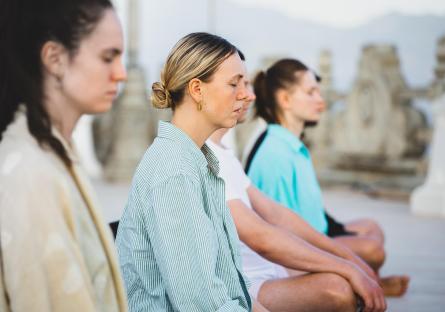
Close your eyes. Try not to think about anything for a moment. Nothing at all. It’s difficult, isn’t it? You try not to think and it’s like a dam breaking open: the stillness of your mind washed away by a tidal wave of ideas, concerns (“did I turn off the stove?”), stray thoughts, and daydreams. Meditation is the art of clearing your mind and sitting in that stillness, and yet the process of quieting all that noise in your head seems like an insurmountable task. Is it worth the effort? If you’re looking to improve your mental health, meditation is absolutely worth it.
Stress Reducer
Studies have found that meditating on a regular basis can help decrease stress and anxiety. The calm state and focused breathing (more on that below) lowers cortisol levels; elevated cortisol levels impact your heart rate and blood pressure. The higher your cortisol levels, the more you're stressed. Meditation is a way to ease off that pressure and relax.
Hones Concentration
Is your attention span weak? Do you feel your mind often wandering? Meditation can help you build up your ability to focus. Research into meditation shows that consistent meditation over time can alter brain patterns, making it easier for someone to control their wandering thoughts. Being able to ignore that distracting inner noise makes it easier to concentrate. Concentration is an important skill to cultivate because it has an impact on your memory and cognition.
Sleep Better
If you’re struggling with your quality of sleep, meditation could be the solution. Meditation induces a relaxation response in the body, which is the opposite of the stress response. In this relaxed state, your body will increase its production of melatonin (the sleep hormone) and serotonin while activating the parts of your brain that control sleep. The calming effect of meditation also cuts down on mental chatter, the kind of ruminating your brain likes to indulge in right before you go to bed.
Manages Pain
For people suffering from chronic pain, studies have found that meditation can help them manage their pain. The calming state of meditation, combined with the increased oxygen flow from breathing exercises, supports the production of pain-killing neurochemicals your brain makes. It also sends more oxygen to your muscles and improves blood flow.
One exercise that's often recommended for people with chronic pain is to do a body scan meditation. This involves lying down in a comfortable position, closing your eyes, focusing on your breathing, and then slowly moving your mental attention from one part of your body to another, paying close attention to whatever sensations that part of you is feeling (including pain) while you try to ignore the rest of your body. If you feel pain in a specific area, breathe through it. Try to observe that painful area without negativity or judgment, and then keep switching your focus to another part of yourself.
Getting Started
We’ve gone over some of the benefits, so let’s dig in briefly on how to meditate. There are a variety of different techniques but the core principle is sitting, trying not to focus on your inner thoughts, and doing intentional breathing. Doing slow and steady breathwork helps induce the calm state of meditation.
Regardless of which of the types of meditation listed below appeals to you, it’s important to have a comfortable and private space to meditate in. An ideal meditation space is an area where you can sit or lie down for at least 5-10 minutes without anyone or anything distracting you. Make sure the room temperature is set at a temperature that you can ignore; if it’s too hot or cold, it’ll pull you out that no-thinking headspace.
Types of meditation to consider include:
- Zazen: This is the classic sitting meditation.
- Guided meditation: A form of meditation in which another person or recording leads you on an inner journey of relaxing imagery, talking you through your meditation.
- Mindfulness: Mindfulness meditation involves focusing on one thing. Maybe it's your breathing, or a picture on a wall. The idea is to center your attention on this one thing without thinking about it or anything else.
- Mantra: This form of meditation involves repeating a calming word or phrase over and over again, using that repetition to drown out other thoughts.
- Tai Chi: A discipline unto itself, Tai Chi can induce a meditative state through its flow of slow movements and focused breathing.
Don’t kick yourself when you start thinking or get distracted during a meditation. It’s bound to happen; even experienced practitioners get distracted sometimes. When your mind wanders and your concentration breaks, don’t get mad or upset. Let that thought pass out of your mind like a bird that’s flown into your home through an open window. Trying to grab it and hustle it out is a waste of time; it’ll find its own way out.
Article by Austin Brietta
Want more wellness tips? Check out these stories: