Listen to the latest episode of the Wave Makers podcast to learn more!
By Mira Radovich, Senior Contributing Writer
Arizona’s housing challenges are about more than affordability. A shortage of construction workers is also making it harder to build the homes and infrastructure the state needs.
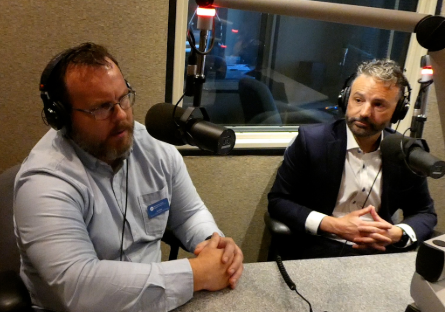
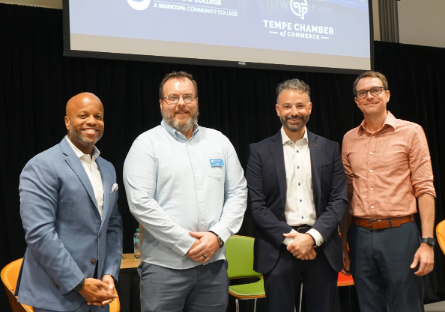
That workforce challenge was a key focus of a new episode of Rio Salado College’s Wave Makers podcast, where host Michelle Reese spoke with Ken Wilk, former chair of applied technology at Rio Salado, and Zach Mannheimer, founder and chairman of 3D printing construction company Alquist 3D.
In the episode, recording in Spring 2026, Wilk and Mannheimer explored how 3D printing could change construction— and create new opportunities for workers.
A new approach to construction
Alquist 3D uses large-scale 3D printing technology to construct buildings. The company began in 2020 with a focus on addressing the housing shortage, but its early work in the commercial sector helped demonstrate the technology’s potential.
The company has completed 3D-printed structures for Walmart, including online pickup and delivery centers. One project was completed in seven days, demonstrating how the technology could improve efficiency and reduce costs as the industry grows.
“We have over 12 more projects with Walmart, and we're growing in size,” Mannheimer said. “Now we're buying millions of pounds of material, which means the cost for material can come down. That was one factor to make housing more affordable using this technology.”
But technology alone won't solve the housing shortage. A skilled workforce will be needed to operate the technology and fill the new roles it creates.
“I think Arizona, for a long time, has been one of the leaders in the nation for growth and construction activity,” Wilk said. “When you really look into the numbers of construction just in this state alone, I believe we need about 200,000 workers in the foreseeable future.”
Rio Salado is partnering with Alquist 3D and local organizations to help address that shortage by developing training opportunities in 3D printing technology.
The college is in the process of creating new workforce classes focused on 3D printing. Through a similar partnership with Ames Community College in Colorado, Alquist 3D created an online course in 3D concrete printing.
The course introduces students to the history of the industry, robotics, materials and coding. Mannheimer said the program also provides an opportunity for experienced construction workers to build new skills and continue working in the industry as the physical demands of traditional construction become more difficult.
“We’ve had over 200 students go through the program,” Mannheimer said. “Many folks in their 40s, 50s and 60s take this course to reskill. These people have been in the construction trades for most of their lives. Their knees hurt, their back hurts. They can't keep up with that type of work, but they still want to be gainfully employed.”
In terms of actual jobs, workers with 3D printing knowledge will be exposed to a variety of opportunities such as computer-aided design, coding, robotics and materials management.
“Students who will come through Rio’s program will be learning how to code and how to develop the design that the robot is printing out,” Mannheimer said. “They'll be the folks at the mix plant figuring out the exact ratio of water to material based upon humidity and temperature, which is the most challenging job on the job site.”
The partnership between Rio Salado and Alquist 3D reflects a broader approach to workforce development: bringing education and industry together to prepare workers for emerging career opportunities.
For Rio Salado, that means helping students develop skills that can translate into real jobs while supporting an industry facing a significant workforce shortage.
Mannheimer believes 3D printing could become a common part of construction within the next five years, working alongside people rather than replacing them.
“We need more schools like Rio to start teaching this,” he said. “I think in the next five years, you're going to see this industry explode.”
Want to hear the whole conversation? Listen now on Podbean or find Wave Makers on your favorite podcast channel: Spotify, Apple Podcasts, YouTube.